Most debt payoff advice has a hidden assumption built in: that you have extra money somewhere in your budget to put toward debt. Earn more, spend less, throw the difference at your balances. It's logical, but it skips the part where some people are genuinely doing everything right with a tight budget and still treading water.
If you're living on a low income with significant debt, the standard playbook doesn't quite fit. But that doesn't mean there's no path forward. It means the tools are different.
Start with a clear picture of where you stand
Before anything else, you need to know exactly what you owe and to whom. List every debt: balance, interest rate, minimum payment, and whether it's current or past due. This sounds basic, but many people dealing with multiple debts have a fuzzy sense of the total, and that fuzziness makes it harder to prioritize.
Add up your minimum payments and compare that number to your take-home income. What's left for everything else? If that number is very small, or negative, you're in a genuine cash-flow problem, and that tells you what kind of help to look for.
When minimum payments are all you can manage
If you're only able to make minimum payments on high-interest debt, almost no progress happens. A $5,000 credit card balance at 24% APR, paying the minimum each month, can take over a decade to pay off and cost thousands in interest (illustrative). The math is brutal.
The interest rate is the problem. That's what makes debt so hard to escape on a limited income. And reducing the rate is the single most impactful lever available to most people in this situation.
The debt management plan option
A debt management plan (DMP) through a nonprofit credit counseling agency is specifically designed for situations where the interest rate is the core problem. Here's how it works: a counselor contacts your creditors and negotiates reduced interest rates, typically down to 6% to 9% from the 20%+ rates many people are paying. You make one monthly payment to the agency, which distributes it to your creditors. The program typically runs three to five years.
You pay the full balance (this isn't debt forgiveness), but at a much lower rate, which means more of each payment goes to principal. For someone on a tight income, the rate reduction can make the difference between a plan that works and one that doesn't. There's usually a small monthly fee, but nonprofit agencies are required to cap fees, and many waive them for people in hardship.
For more detail on how DMPs work, the full debt management plan explainer covers eligibility, what to expect, and the difference from settlement. You'll also want to understand how DMPs compare to consolidation and settlement before choosing a path.
Debt settlement: the trade-offs on a low income
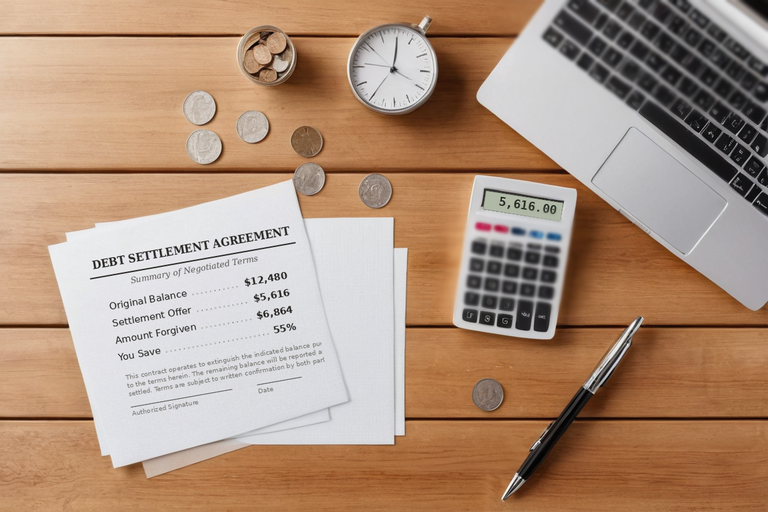
Debt settlement, which involves negotiating to pay less than you owe, is sometimes marketed as the solution for people who can't make payments. It's worth understanding what it actually involves.
Settlement typically requires you to be significantly behind on payments, at which point creditors may be more willing to accept a lump sum for less than the full balance. The trade-offs are real: serious credit damage, potential lawsuits from creditors during the delinquency period, and the forgiven amount may count as taxable income. See the full breakdown of debt settlement for a clear picture of the process.
Settlement may make sense in specific situations (large unsecured debt, already severely delinquent, no viable path to pay in full), but it's not a shortcut, and the risks are higher than the marketing often implies.
Tackling the income side
On a tight income, finding any additional cash flow matters more than optimizing the method you use to pay debt. Even $100 to $200 extra per month changes the math significantly over a year.
Some realistic options that don't require long ramp-up times:
- Selling items you own but don't use (furniture, electronics, clothing) generates one-time cash that can go directly to your highest-rate debt
- Picking up extra hours at an existing job, if available, avoids the setup time of a second job
- Gig work (delivery, rideshare, task-based apps) has low barriers to entry; you can start within days in most cities
- If you have a skill (writing, tutoring, handyman work, childcare), one-off gigs or word-of-mouth clients often pay more per hour than platform-based work
For ideas and realistic expectations on side income, the side hustles that pay well guide covers options by time commitment and skill level.
Budget first, everything else second
On a low income, there's no margin for waste. A zero-based budget assigns every dollar of income to a specific category, including minimum debt payments and whatever extra you can put toward the highest-rate balance. It's the most effective tool for making sure the money you do have is working as hard as possible.
The zero-based budget guide walks through the setup in plain terms. If you've tried budgeting before and found it hard to stick to, that guide also covers common reasons budgets fall apart and how to fix them.
Don't ignore assistance programs
If your income is very low, you may qualify for assistance programs that reduce your essential expenses, freeing up more money for debt. Utility assistance (LIHEAP), food assistance (SNAP), and healthcare coverage through Medicaid all reduce fixed monthly costs if you qualify. A reduction in your utility or grocery bill of even $100 per month is the equivalent of finding extra debt-payoff money without earning more.
Community action agencies in most counties can help you identify which programs you might qualify for. Many people in financial difficulty don't know what's available.
What won't help
A few things that get marketed as solutions but tend to make things worse on a low income:
Payday loans and cash advance apps charge extremely high effective interest rates. Borrowing to make a credit card payment almost always increases your total debt burden. High-fee debt consolidation loans (some marketed aggressively to people with damaged credit) can carry rates as high as the debt you're consolidating, with additional fees on top.
If someone is guaranteeing debt elimination with no credit impact for a fee paid upfront, that's a red flag. Legitimate credit counseling agencies are nonprofit, transparent about fees, and don't promise results they can't deliver.
Important disclosure: Debt relief programs aren't right for everyone, and results vary. Some programs may affect your credit score and could have tax consequences. Stopping payments or enrolling in certain programs can lead to collection calls or legal action by creditors. Review all terms carefully and consider speaking with a qualified financial professional about your specific situation. We may earn compensation when you use our partner links.
Your next step
If the interest rates on your debt are making it impossible to make real progress on a tight income, a debt management plan is worth a close look. CareOne Debt Solutions offers free consultations through certified credit counselors, with no obligation or sales pressure. A counselor can review your debts, income, and expenses and tell you whether a DMP would actually help your situation.
This article was generated with the assistance of AI and reviewed for accuracy. It is for general educational purposes only and is not financial, tax, or legal advice.